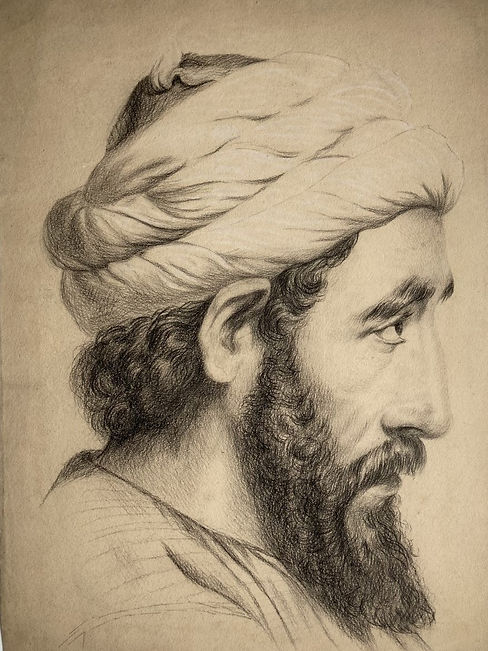
European School, late 19th century
Portrait of Georg August Wallin
Black chalk heightened with white
340 x 255 mm
Provenance:
Private Collection, UK
This arresting study of Georg August Wallin (1811-1852) is one of six known examples of the portrait, two of which are currently offered by Antico Fine Art. Although Wallin’s name may be largely unfamiliar to readers today, he is a central figure in the story of European exploration in the Middle East and was much lauded contemporaneously for his daring tale and ground-breaking field research. Wallin was Fenno-Swedish Orientalist, linguist and explorer who spent six years between 1843 and 1849 living in the Middle East and northern Arabia under the guise of an Egyptian-Arab doctor named ‘Abd Al-Wali’. As the first European to explore many of these regions, and as one of the first to have completed the pilgrimage to Mecca, Wallin’s experiences were of great intrigue to a public giddy with Egyptomania.
Wallin travelled widely between Constantinople and Cairo, passing through Baghdad, Jerusalem, Medina and Alexandria, although his most edifying experiences came amongst the Bedouin tribes of the desert. His journals detail colourful anecdotes of campfire scenes, close shaves with bandits and encounters of the ‘other’. His disguise and thorough knowledge of the Qur’an even led to scenarios in which he was obliged to officiate make-shift religious ceremonies, performing rituals at both weddings and funerals. As a student however, travelling under the premise of doctoral research, Wallin’s journals also include much of academic significance, including information on Bedouin poetry and Arabic linguistics. Adept with instruments as he was with languages, Wallin’s notes also include transcriptions of musical melodies, adding colour to his literary images and providing another field of study with invaluable source material.
In 1849 Wallin returned to Europe and in 1851 he finally completed his doctoral thesis, winning prizes from the Geographical Society of Paris, the East India Company in London and receiving a “Royal Award for Literary Merit”. In 1851 he took up a professorship of Oriental literature at the University of Helsinki but died soon afterwards a day before his 41st birthday. Wallin’s posthumous reputation has suffered outside of his native Finalnd in part for his early death and the unfinished projects left behind and in part for the inaccessibility of his Finnish and Swedish writings. This has recently been righted with translations of many of his journals now thankfully available in English.
The present drawing closely follows the only known portrait of Wallin made from life which was drawn by the elusive C. Cajander between 1847-9 [fig. 1]. Nothing is known of Cajander and no other drawings from their hand are known. The dating of the portrait also makes it unclear as to whether it was made before or after Wallin’s return to Europe. He is clad in traveller’s garb with a tightly curled beard and has yet to revert to the more conventional appearance seen in Johanna Ramstedt’s deathbed portrait. In Ramstedt’s later image Wallin is portrayed with slicked back hair and a much shorter beard. Ramstedt’s portrait would form the basis of Wallin’s likeness in Robert Ekman’s celebrated posthumous portrait, which now holds pride of place in the Helsinki University Museum [fig. 3].
Exactly how Cajander’s portrait of Wallin entered wider circulation is unclear, although it evidently left some enduring impression on late 19th century European artists since at least 6 different versions of the portrait are known, all of which are attributed to different artists, working in different countries, and operating in different eras. The British artist Frederick Sandys (1806-1886) first reproduced the portrait in 1857; the Spaniard Cecilio Pizarro then drew an undated version which is currently offered by Antico Fine Art [fig. 2]; the American George Henry Hall (1825-1913) made a fourth version in 1881; and the Italian-Turkish Leonardo da Mango (1843-1930) made a final version in 1910. Although the present drawing is unsigned and undated, the reproduction of a model drawing and the academicism of draughtsmanship indicate that the work was executed by a classically trained artist in the latter part of the 19th century, perhaps as an academy exercise. In spite of this proliferation of images, the sitter’s identity had been forgotten in connection with these portraits until now.

Fig. 1: C. Cajander, Portrait of Georg August Wallin, Museovirasto, Helsinki
_edited.jpg)
Fig. 2: Cecilio Pizarro, Portrait of Georg August Wallin, with Antico Fine Art

Fig. 3: R.W. Ekman, Portrait of Georg August Wallin, Museovirasto, Helsinki
.jpg)