George Lance
Little Easton 1802 – 1864 Birkenhead
A monkey cutting a melon, or ‘Jocko’ at lunch
Brown wash and white heightening
570 x 450 mm
Provenance:
Nelia Barletta de Cates (1932 - 2003), Paris;
Her sale, Christie’s, Paris: 18 March 2003 [Lot 171] (as “Ecole Française XIXème siècle”);
Private collection, Paris

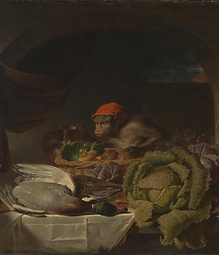
This large and highly finished drawing of a monkey cutting a melon by the British artist George Lance likely represents the final preparatory stage for a painting entitled ‘Jocko’ at lunch, which is currently housed at the Williamson Art Gallery & Museum in Birkenhead [fig. 1]. The comparable dimensions of the two works (540 x 467 mm; 570 x 450), and the divergence in certain details, such as the angle of the monkey’s head, the half-eaten slice of watermelon between the monkey’s legs and the feather attached to its cap, support the hypothesis that the drawing is a preparatory model and not a riccordi.
Lance was perhaps the most renowned British still life painter of the early 19th century, and a number of his works are compositionally comparable with the present drawing, showing a monkey perched beside a bounteous still life of fruit. Many of Lance’s compositional props used in this drawing, such as the wove brown mat and the richly embroidered curtain, can be recognised in these other works. The most renowned of these “monkey still lives” is The Red Cap, which was presented to the Tate in 1847 by Lance’s earliest and most loyal patron, Robert Vernon [fig. 2]. The work is believed to be a “gentle lampoon of human foibles, but may also be a more biting comment on the political realities and socialist unrest of mid-century Europe”. In the present example Jocko, the monkey, dressed in a velvet jacket and finery beside an overflowing basket of ripe fruit, halts his feast to lock eyes with a sparrow. Although he has more food than he could possibly eat laid out before him, he still stops to consider the added possibility of the bird, or perhaps he is simply torn between food and play. Another painting of this kind appeared on the market at Bonhams in 2019.
Lance’s artistic career began following a chance encounter in the British Museum with Charles Landseer, who was himself drawing from the newly installed Parthenon Marbles. The fourteen-year-old Lance sought out Landseer’s master, Benjamin Haydon, and requested his tutelage, which was readily given free of charge on the evidence of Lance’s nascent talent. This fledgling artistic career was a far cry from Lance’s first post-school position, which was in a Yorkshire mill, however the change of profession turned out to be a prescient move. During Lance’s later years in Haydon’s studio, he also attended classes at the Royal Academy School and in 1824, he began exhibiting at the annual Academy shows. It was in these final years that he decided to focus on still life painting, drawing inspiration from the Dutch artists of the seventeenth century, Jan van Huysum in particular. This was in part a pragmatic decision since Lance came from a modest family with little financial support and had already witnessed the humiliating reality of debtors prison when Haydon was unceremoniously incarcerated. Thanks to a series of wealthy patrons however, Lance would escape the fate of his teacher and thrive. In addition to Vernon, who purchased his first still life from Lance in 1826 and whose collection of British art would eventually form the foundation for what is now Tate Britain, Lance counted amongst his patrons the estates of Woburn Abbey and Blenheim Palace. Lance’s embrace of still life painting as a legitimate genre in the 1820s makes him a pioneer in the still life revival movements of the 1830s and 1840s throughout Europe.
Whilst numerous paintings by Lance can be seen in international institutions such as the Rijksmuseum, Amsterdam, and the Victoria and Albert Museum, London, drawings and watercolours are rarer. A fine example however can be seen in the British Museum, London, and another in the National Portrait Gallery, London. A further small group of watercolours of fruits from a private collection is recorded in John Radcliffe’s 2016 biography of Lance. The present drawing is previously unpublished and was first recorded as a drawing of the “Ecole Française XIXème siècle” whilst in the collection of Nelia Barletta de Cates. Cates was the Dominican Republic’s cultural attaché and a “grande dame” of European society. Her Paris apartment on the Avenue Matignon, where the drawing once hung, had formerly been home to Loel and Gloria Guinness and was decorated by Georges Geoffroy, high society’s favoured designer in the 1950s. The drawing can be seen in its former position above the bureau of the “chambre d’ami” in the Christie’s catalogue of Cates’ estate sale [fig. 3].
.png)
Fig. 1: George Lance, 'Jocko' the Monkey, Williamson Art Gallery & Museum, Birkenhead
.png)
Fig. 2: George Lance, 'The Red Cap, Tate Museums, London
.png)