Johannes Friedrich Ebert, called Fritz
Dresden b. 1868
Artists sketching at the fountain of Nymphenbad
Signed: F. Ebert Dresden; inscribed and dated: Nymphenbad 23/4. [18]90.
Pencil
270 x 340 mm
Provenance:
Private Collection, Germany
This charming study of young artists sketching en plein air at the fountain of Nymphenbad provides an amusing insight into the academic practices of the Kunstgewerbeschule in Dresden in the late 19th century. The Baroque fountain of Nymphenbad forms part of a pavilion complex set within the palatial gardens of Zwinger, perhaps Dresden’s most iconic architectural monument and now home to the city’s collection of Old Master paintings. As the practice of drawing from nature and painting en plein air grew in popularity across the 19th century, it became institutionalised and taught in schools of applied arts, as in the present example with Dresden’s Kunstgewerbeschule. During the 18th century the gardens of Arcueil near Paris became a popular topos for French landscape artists, with Jean-Baptiste Oudry in particular associated with the region. Over the following century the fountain of Nymphenbad, with its rich assortment of potential viewpoints, had an equally magnetic pull, drawing in an array of artists from JMW Turner to Adolph von Menzel, in addition to the students of local academies.
No other works by the elusive Fritz Ebert are known, and scant biographical information pertaining to his life remains. He was born in Dresden in 1868 and enrolled at the Dresden School of Applied Arts in the winter of 1885. In 1890 Ebert was still a student and likely in his final year at the academy. On a sunlit late-April day he depicts his fellow students in an array of poses at their parasol-shaded easels by the fountain of Nymphenbad, readily identified by the rusticated brickwork at right. The Ebert family had moved to Dresden some 75 years previously, when in 1814 Friedrich Adolf Ebert (1791-1834), the celebrated bibliographer and librarian, secured a position at the Royal Library of Dresden. He would rise to the position of chief librarian before suffering the inescapably ironic fate of falling to his death from a ladder in the library in 1834. Johannes Friedrich was likely a scion of the ill-fated Friedrich Adolf.
Research into pre-Bauhaus artistic education in Germany has long been a lacuna. In response to the changing conditions imposed by industrialisation, schools of arts and crafts, such as the Dresden Kunstgewerbeschule, emerged as innovative centres for artistic and practical training. A new research project planned for publication in late 2025 is underway at the Staatliche Kunstsammlungen Dresden with the hope of providing a more rounded overview of the movement, its teaching methods and practices.
.jpg)
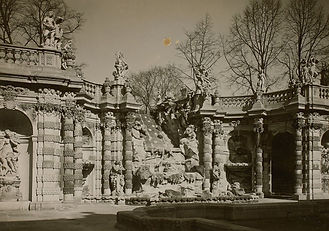
Fig. 1: Nymphenbad, c. 1900, photograph